Why does a team miss its sprint goal again, even after a long talk about the plan? On one team, the answer came out during a Friday review, when each member described a different way of working.
Part of the answer is vocabulary. People use the words agile, Scrum and Kanban as if they mean the same thing, but they do not.
Agile is a mindset. Scrum and Kanban are two working methods that put that mindset into practice.
The choice between Scrum and Kanban decides how work is planned, how it moves and how progress gets tracked. This article explains each term, compares Scrum and Kanban side by side, and gives a simple way to choose. Kanban also uses a work-in-progress limit, which is a fixed cap on how many tasks a column may hold at once.
Many teams skip the vocabulary and argue about tools instead. The first useful step is to see what agile means in practice.
Key Takeaways
- Agile is a mindset built on values, not a set of fixed steps.
- Scrum runs work in fixed sprints, usually two to four weeks long.
- Kanban runs work as a continuous flow on a board with work-in-progress limits.
- The right choice depends on the type of work and the team’s needs.
- Sprints often slip when team members follow different processes.
What Agile Means as a Mindset
Agile is a set of values and principles, not a method with steps. The idea started with the Agile Manifesto, which seventeen software developers wrote in February 2001.
The Manifesto sets out four values. It ranks individuals and interactions over processes and tools. It also ranks working software over comprehensive documentation.

The other two values rank customer collaboration over contract negotiation, and responding to change over following a plan. The Manifesto also lists twelve principles that support these values.
Many people treat agile as an agile methodology with fixed steps, but it has none. Agile does not set daily meetings, fixed roles or a set length for each cycle of work. A team can follow its values without using Scrum or Kanban at all.
Agile is a mindset, not a checklist. A team that copies the words without the values gets little benefit.
Many teams say they are agile, yet they follow no defined practice. Meetings happen when someone remembers them, and nobody writes down how work is chosen. Calling the work agile does not close that gap.
The values give a team a shared starting point. Scrum and Kanban are the two agile methodologies most teams use to turn those values into daily work. Each one handles changes and priorities in its own way, and the next step is to see how Scrum does it.
How Scrum Organizes Work Into Sprints
A Scrum sprint is a fixed work cycle that usually lasts two to four weeks. Two weeks is the most common length, and the team keeps the same length from one sprint to the next.

Scrum runs each sprint through five parts in a set order. The team uses them to plan, check progress and learn from each cycle.
- The Sprint, the fixed cycle that holds the other events
- Sprint Planning, where the team sets the sprint goal
- Daily Scrum, a short check-in on progress and blockers
- Sprint Review, where the team shows finished work
- Sprint Retrospective, where the team looks at how it worked
Sprint Planning and the Product Backlog
During sprint planning, the team picks items from the product backlog and sets one sprint goal. The product backlog is the ordered list of work, and the product owner keeps it up to date. The product owner ranks each item by value, so the team knows what matters most.
Team members choose how much work they can finish in the sprint. The product owner does not make that call alone, because the team’s own estimates shape the plan.
Daily Scrum, Sprint Review and Retrospective
The daily Scrum is a 15-minute meeting where team members share progress, plans and blockers. It keeps the sprint on track without long status reports.
At the sprint review, the team shows finished work to stakeholders and gathers feedback. The retrospective comes last, when the team picks one change to try in the next sprint.
The Three Scrum Roles
Scrum has three roles: the Product Owner, the Scrum Master and the Developers. A scrum master in software development works as a coach, not as a traditional project manager. The Scrum Master removes blockers, such as a missing approval, so the team can keep working.
The Developers choose the work they will do in the sprint and decide how to build it. The team also has one common mistake: it changes the sprint goal in the middle of the sprint. When scope keeps getting added, sprints slip, because the work no longer matches the plan. Kanban takes a different path, because it has no fixed cycle to plan around.
How Kanban Keeps Work Flowing Without Sprints
Kanban runs work as a continuous flow on a board, with no fixed sprints. A support team using Kanban pulls the next ticket as soon as one closes, so work keeps moving.
Columns, Cards and the Kanban Board
The kanban board shows work as cards in columns. A basic board has three columns: To Do, In Progress and Done. Each card is one task, and it moves to the right as work advances.
The kanban methodology uses the board as its core tool. Kanban started at Toyota in manufacturing, and it comes from lean thinking about cutting waste. Teams can add columns for each stage of their workflow, such as Review or Testing, to match how their work really moves.
Work-in-Progress Limits and Bottlenecks
Teams usually set limits per column, often matched to the number of people working in that stage. For example, three designers share a Designing column with a limit of three cards, so a fourth card waits in To Do.
Limits also show bottlenecks. When one column fills up and stays full, the work behind it piles up, and the team sees the problem on the board. Teams use that signal for continuous improvement of the process.
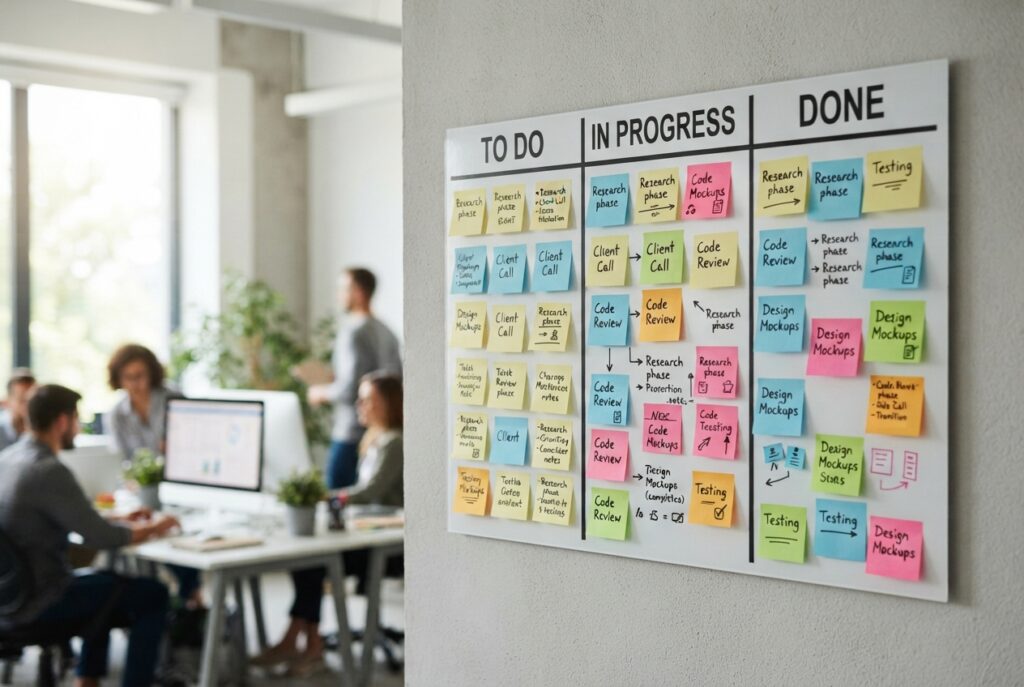
Clients of a web development agency can use a kanban board to list tasks and track progress. Put simply, agile vs kanban in daily work comes down to rhythm. Scrum sets a steady beat of sprints, while Kanban lets the board set the pace.
| Aspect | Scrum | Kanban |
|---|---|---|
| Cadence | Fixed sprints of two to four weeks | Continuous flow with no fixed cycle |
| Required roles | Product Owner, Scrum Master, Developers | None required; the team keeps its titles |
| Change handling | Changes wait until the next sprint | New work enters when a column has room |
| Main metric | Velocity, the work finished per sprint | Cycle time, the time a task takes to finish |
Scrum and Kanban share more ground than the table suggests. Both use visible work, short feedback loops and a focus on finishing what has started.
Agile vs Scrum: Which Is Better for a Given Team
Agile is not a rival to Scrum. It is the broader approach that Scrum belongs to, so the real question is which practices a team needs.
When people ask about agile vs scrum, they usually want to know which habits fit their team. A team can take several agile practices without adopting Scrum at all.
- Short iterations, so the team learns in weeks instead of months
- A customer or stakeholder review after each piece of work
- A shared backlog that everyone can see and reorder
- A short daily check-in on progress and blockers
- A written definition of done for each task
Scrum fits complex product development with stable goals for each sprint. Kanban fits ongoing support and maintenance work, where priorities shift often.
A team that adopts Scrum rules without the agile principles often sees sprints slip. The meetings happen, but nobody questions a plan that stopped matching the work. A simple test for framework choice is whether the team finishes the goal it set.
Some product teams start with planning that turns early ideas into a roadmap. The consultations offered by a SaaS app development company show one way to do that. Scrum and Kanban differ on several points, and their pros and cons come into focus once the work is clear.
Scrum vs Kanban Board: What Each Looks Like Day to Day
On a Monday morning, a Scrum board shows only the tasks for the current sprint, while a Kanban board shows everything in progress. In daily use, the scrum vs kanban board difference comes down to time frame.
What a Scrum Board Shows
A scrum board holds the items chosen for the current sprint, grouped in columns such as To Do, In Progress and Done. The team moves cards as they finish work, and the board resets when a new sprint starts. Items the team did not commit to stay in the product backlog until a later sprint.
Many teams run Scrum on a kanban board and still follow Scrum rules. The board looks like a flow board, but the sprint still sets the rhythm.
What a Kanban Board Shows
A kanban board shows all active tasks at once, with no reset at the end of a cycle. A design team might see twelve cards in progress, with four waiting in Review. Columns can match each stage of the workflow, and cards keep moving as work finishes.
Burndown Charts and Cumulative Flow Diagrams
A burndown chart shows the work left in a sprint, dropping day by day toward zero. A cumulative flow diagram shows how many items sit in each stage over time, and where work piles up.
A common mistake is to use a burndown chart on a flow board. A Kanban board has no sprint to count down, so the chart says little. A cumulative flow diagram gives the clearer picture of progress on that board.
Both boards answer different questions, and both carry real strengths and costs. Those trade-offs decide which board a team will keep using.
Pros and Cons of Scrum and Kanban
Scrum’s main advantage is its fixed increments and clear roles, and its main cost is the cultural change it demands. Teams that want a set rhythm usually accept that cost.
When you weigh scrum vs kanban pros and cons for small teams, start with how often the team needs to plan together. A small team with a steady plan may find Scrum helpful, while a small team with constant requests may feel the weight of planning meetings.
- Scrum advantages: fixed increments of work, clear roles, and a set planning rhythm that keeps everyone on one schedule.
- Scrum drawbacks: it needs a cultural change, and a team may get stuck in ceremony, with meetings that stop adding value.
- Kanban advantages: it starts from the existing process, needs no new roles, and adapts quickly to shifting priorities.
- Kanban drawbacks: it has no built-in planning cadence, so improvement is left to chance, and deadlines are harder to plan around.
Team collaboration is strong in both, but it looks different. Scrum builds it through daily meetings and shared reviews. Kanban builds it through the board, where everyone sees the same work and can speak up when a column jams.
Flexibility is where the two split most. Kanban gives more room for changes mid-stream, while Scrum gives more predictable planning. These trade-offs point to a practical question: which framework fits this team’s work?
Choosing Between Scrum and Kanban for Your Team
A team with fixed-scope product work leans toward Scrum, and a team with ongoing requests leans toward Kanban. The type of work matters more than the size of the team.
| Work type | Best fit | Cadence | First step |
|---|---|---|---|
| New product features | Scrum | Two-week sprints | Hold sprint planning with a ranked product backlog |
| Support and maintenance | Kanban | Continuous flow | Set up a board with a work-in-progress limit per column |
| Web design and app releases | Scrum or Scrumban | Sprints with a flow board | Map the user flows, then split them into sprint items |
A design team that maps user flows and site maps for a new app can plan fixed releases with Scrum. The same team can add a flow board for design feedback that arrives all week. Teams often combine the two, and Scrumban keeps sprints while adding a flow board.
Start with the framework the team will actually keep. A method the team ignores after two weeks helps no one, no matter how well it fits on paper. Choosing a framework that matches the team’s habits is the first step toward a clear process.
A good choice still breaks down when the team cannot follow its own process. The most common causes of that breakdown show up in the sprints themselves.
Why Sprints Keep Slipping and How Teams Agree on a Process
A sprint goal that changes twice in one week is a common cause of slipping sprints. Each change pulls the team toward new work, and the progress on the first goal stalls.
Three causes show up most often, and each one has a clear fix.
- Mid-sprint scope additions: freeze the sprint goal, and park new requests in the product backlog for the next sprint.
- An unrefined backlog: refine the top items before planning, so the team knows what done means for each one.
- Mixed processes: write one process down, and have every team member follow it for the same cycles.
Agreeing on one process is the hard part. Write the process on one page, then trial it for three sprints before changing any step. A team that changes its rules every week never learns whether they work.
A sprint that keeps changing its goal will keep slipping. Write one process down and test it before changing it.
Hold a short review at the end of the trial, and keep a change only when progress improves. This is what continuous improvement looks like in practice, with small steps and a clear record. With one process agreed, the team can finally judge whether Scrum or Kanban is doing its job.
Conclusion
Agile is the mindset, while Scrum and Kanban are the methods that put it into practice. Scrum organizes work into sprints, and Kanban keeps work flowing on a board with limits. Neither one fixes a team by itself.
Your next step is simple. Write down how your team works today, then choose one framework and test it for two sprints or cycles. Start with that page this week, and bring it to your next planning meeting.